Wei Kang

AskDogWise

Medium:

Interactive web experience — hand-drawn frame-by-frame animation, large language model, generative image output, Next.js

Dimension:

1920x1080 (responsive web, optimized for mobile portrait)

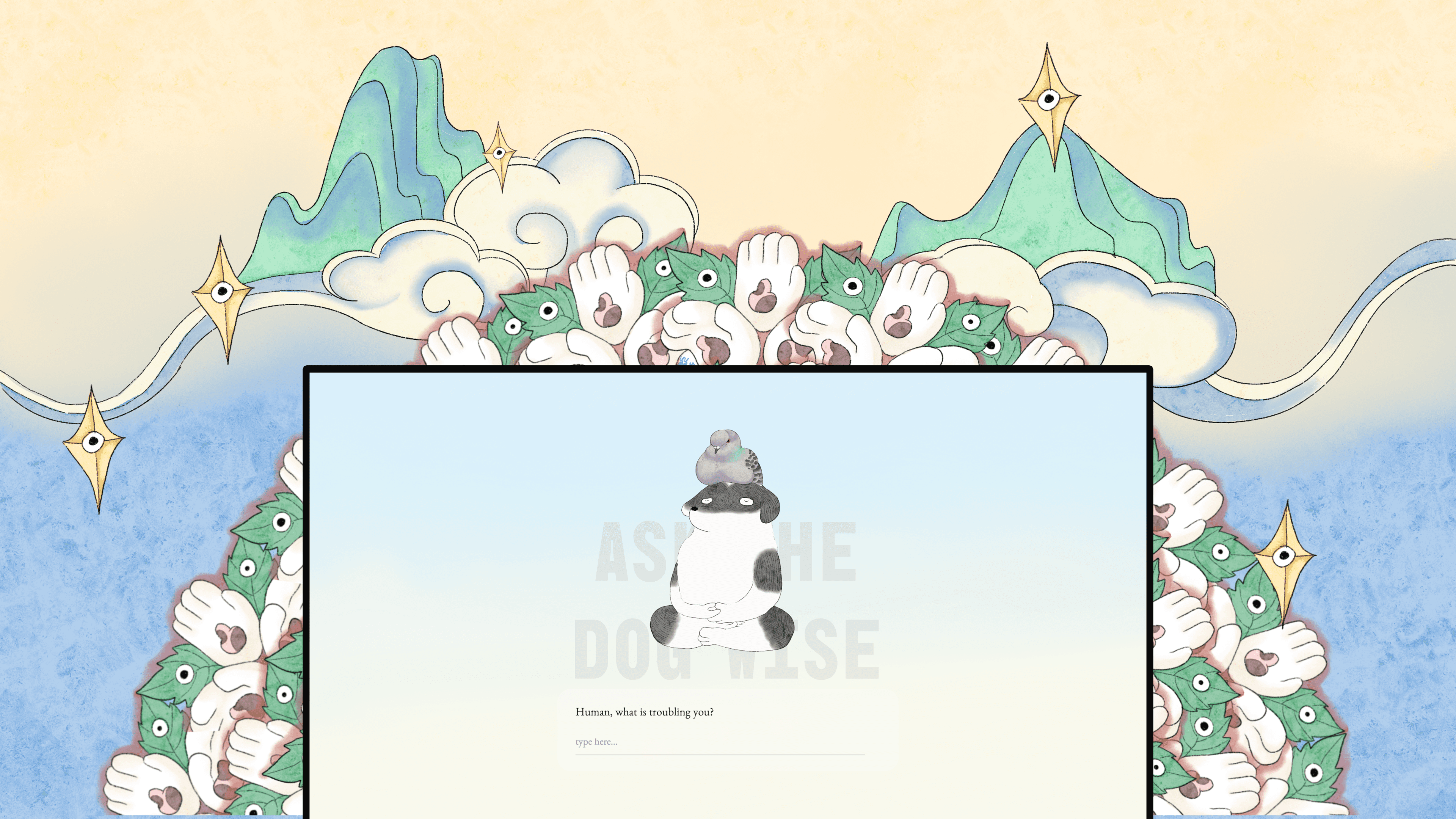
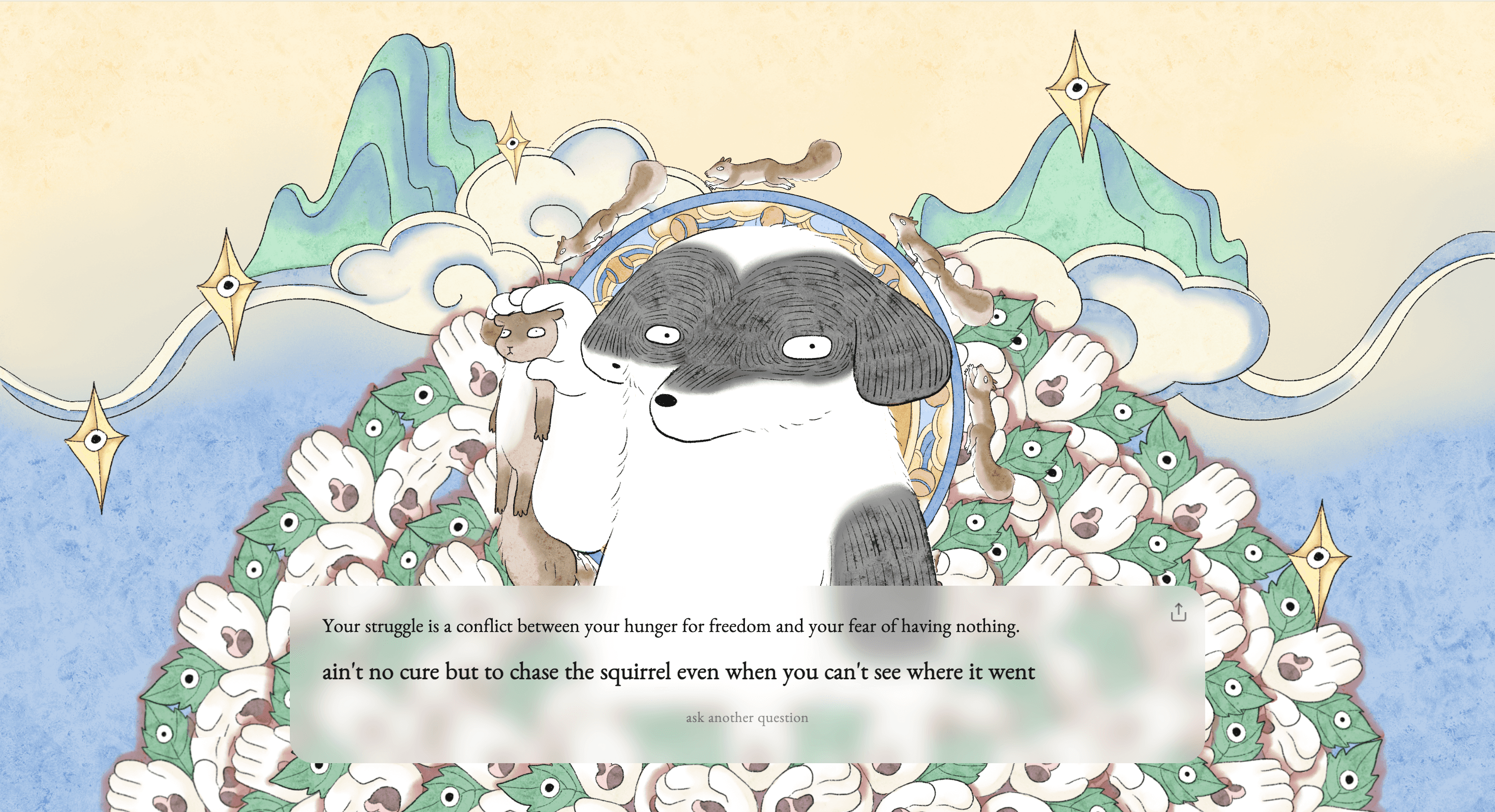
Concept: AskDogWise began as a dog jokes comic — a simple observation that dogs handle life better than we do. When a dog meets another dog, it wags, and the other dog knows immediately. Humans smile at people they dislike. Dogs are not wise because they are intelligent. They are wise because nothing gets in the way between the feeling and the response. This work proposes a new kind of intelligent interaction: one that deliberately withholds solutions. Through four rounds of structured conversation, the dog identifies the user's core contradiction — not to resolve it, but to name it. The insight must be completed by the person who asked. Creative Technique: Each animation frame was hand-drawn on iPad and exported as PNG sequences. The conversation logic applies the AFC framework (Actor, Force, Condition — developed by Wei Kang) through a custom-prompted language model. A shareable image is generated at session's end, designed for social distribution. Theme Response: AskDogWise's images are its architecture. It is a different claim than generative imagery makes. Rather than producing new pixels, the system produces new context. The prompt is invisible. The narrative is personal. In this way AskDogWise proposes that the future of image-based interaction lies not in endless generation, but in intelligent curation of the interaction.

About the Artist

Wei Kang

Wei Kang is an artist and AI builder based in New York. By training she is an AI product manager; by practice, a gongbi artist, cartoonist and animator. Her work lives at the edge of two disciplines: hand-drawn illustration and the design of conversational AI systems. Wei is optimistic about AI — and deeply concerned about how humans interact with it. Human wisdom, she believes, comes from dialectic: the friction of thinking something through. But as AI systems compress conversation, skip the middle, and deliver conclusions directly, the human becomes a passenger. There is no longer an equal exchange. There is only a prompt and a reply. In response, Wei developed the AFC framework — a conversational structure in which AI never gives an answer. Instead, it surfaces the conflict: asking about the Actor, the Force, and the Condition shaping a person's trouble. The goal is not resolution. It is recognition. AskDogWise is where that conviction met her art. The dog — her muse, a recurring figure across years of illustration and comic work — became the perfect vessel. He holds no agenda. He carries no framework. He sees your problem the way a dog sees most things: simply, directly, and without the weight of consequence.
Wei Kang

AskDogWise

Medium:

Interactive web experience — hand-drawn frame-by-frame animation, large language model, generative image output, Next.js

Dimension:

1920x1080 (responsive web, optimized for mobile portrait)

Concept: AskDogWise began as a dog jokes comic — a simple observation that dogs handle life better than we do. When a dog meets another dog, it wags, and the other dog knows immediately. Humans smile at people they dislike. Dogs are not wise because they are intelligent. They are wise because nothing gets in the way between the feeling and the response. This work proposes a new kind of intelligent interaction: one that deliberately withholds solutions. Through four rounds of structured conversation, the dog identifies the user's core contradiction — not to resolve it, but to name it. The insight must be completed by the person who asked. Creative Technique: Each animation frame was hand-drawn on iPad and exported as PNG sequences. The conversation logic applies the AFC framework (Actor, Force, Condition — developed by Wei Kang) through a custom-prompted language model. A shareable image is generated at session's end, designed for social distribution. Theme Response: AskDogWise's images are its architecture. It is a different claim than generative imagery makes. Rather than producing new pixels, the system produces new context. The prompt is invisible. The narrative is personal. In this way AskDogWise proposes that the future of image-based interaction lies not in endless generation, but in intelligent curation of the interaction.

About the Artist

Wei Kang

Wei Kang is an artist and AI builder based in New York. By training she is an AI product manager; by practice, a gongbi artist, cartoonist and animator. Her work lives at the edge of two disciplines: hand-drawn illustration and the design of conversational AI systems. Wei is optimistic about AI — and deeply concerned about how humans interact with it. Human wisdom, she believes, comes from dialectic: the friction of thinking something through. But as AI systems compress conversation, skip the middle, and deliver conclusions directly, the human becomes a passenger. There is no longer an equal exchange. There is only a prompt and a reply. In response, Wei developed the AFC framework — a conversational structure in which AI never gives an answer. Instead, it surfaces the conflict: asking about the Actor, the Force, and the Condition shaping a person's trouble. The goal is not resolution. It is recognition. AskDogWise is where that conviction met her art. The dog — her muse, a recurring figure across years of illustration and comic work — became the perfect vessel. He holds no agenda. He carries no framework. He sees your problem the way a dog sees most things: simply, directly, and without the weight of consequence.
Wei Kang

AskDogWise

Medium:

Interactive web experience — hand-drawn frame-by-frame animation, large language model, generative image output, Next.js

Dimension:

1920x1080 (responsive web, optimized for mobile portrait)

Concept: AskDogWise began as a dog jokes comic — a simple observation that dogs handle life better than we do. When a dog meets another dog, it wags, and the other dog knows immediately. Humans smile at people they dislike. Dogs are not wise because they are intelligent. They are wise because nothing gets in the way between the feeling and the response. This work proposes a new kind of intelligent interaction: one that deliberately withholds solutions. Through four rounds of structured conversation, the dog identifies the user's core contradiction — not to resolve it, but to name it. The insight must be completed by the person who asked. Creative Technique: Each animation frame was hand-drawn on iPad and exported as PNG sequences. The conversation logic applies the AFC framework (Actor, Force, Condition — developed by Wei Kang) through a custom-prompted language model. A shareable image is generated at session's end, designed for social distribution. Theme Response: AskDogWise's images are its architecture. It is a different claim than generative imagery makes. Rather than producing new pixels, the system produces new context. The prompt is invisible. The narrative is personal. In this way AskDogWise proposes that the future of image-based interaction lies not in endless generation, but in intelligent curation of the interaction.

About the Artist

Wei Kang

Wei Kang is an artist and AI builder based in New York. By training she is an AI product manager; by practice, a gongbi artist, cartoonist and animator. Her work lives at the edge of two disciplines: hand-drawn illustration and the design of conversational AI systems. Wei is optimistic about AI — and deeply concerned about how humans interact with it. Human wisdom, she believes, comes from dialectic: the friction of thinking something through. But as AI systems compress conversation, skip the middle, and deliver conclusions directly, the human becomes a passenger. There is no longer an equal exchange. There is only a prompt and a reply. In response, Wei developed the AFC framework — a conversational structure in which AI never gives an answer. Instead, it surfaces the conflict: asking about the Actor, the Force, and the Condition shaping a person's trouble. The goal is not resolution. It is recognition. AskDogWise is where that conviction met her art. The dog — her muse, a recurring figure across years of illustration and comic work — became the perfect vessel. He holds no agenda. He carries no framework. He sees your problem the way a dog sees most things: simply, directly, and without the weight of consequence.