Manming Luo

Lumina Echo

March 2026

Medium:

Interaction Design

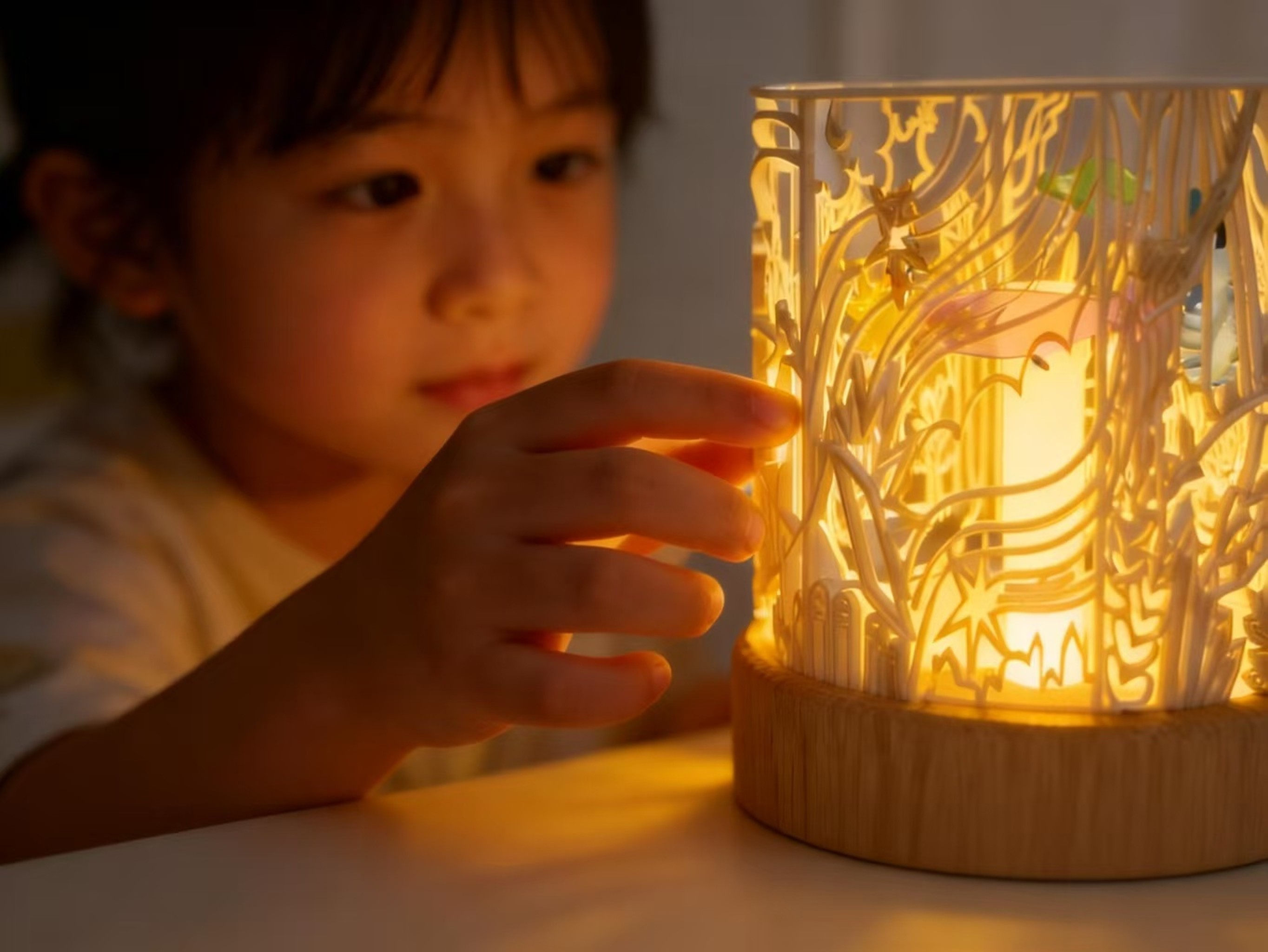
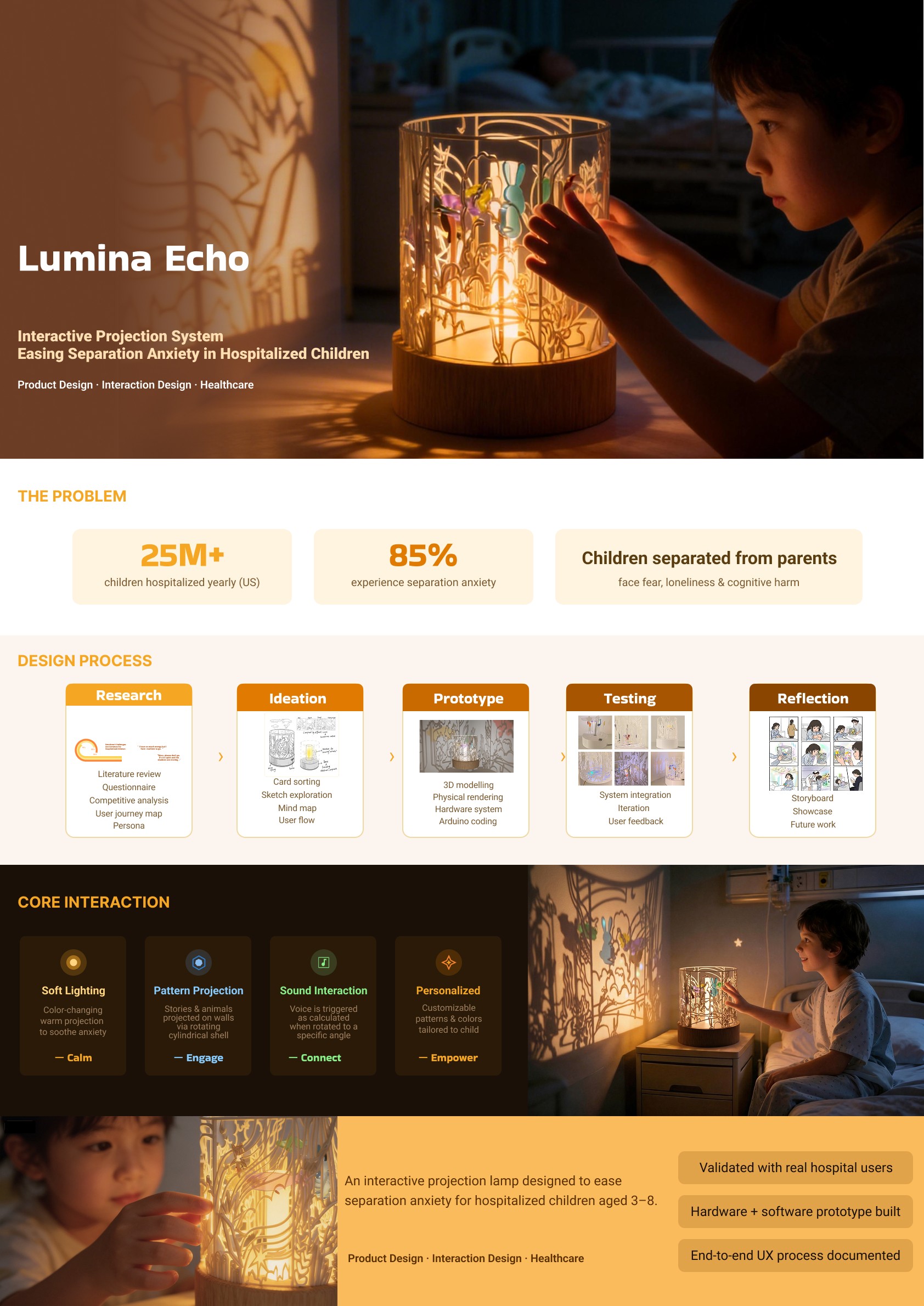
Each year, over 25 million children are hospitalized in the United States. Separated from their parents during procedures and overnight stays, many experience acute separation anxiety — fear, disorientation, and a profound loss of agency that can slow recovery and leave lasting psychological impact. Yet the designed environment of the pediatric ward has changed little in decades. Lumina Echo is a response to that silence. The device projects layered light patterns — forests, animals, constellations drawn from children's visual language — across the walls of a hospital room, turning a clinical space into something inhabited and personal. A rotating cylindrical shell with hand-cut imagery casts shifting shadows as children touch and turn it, while embedded sound responses make the environment feel alive and attentive. Developed through eight months of research with children, caregivers, and medical staff, and validated across three rounds of hospital-based interaction testing, Lumina Echo integrates physical craft, interaction design, and electronic engineering into a single coherent object. It is not a medical device. It does not treat the illness. It simply ensures that while a child waits — in an unfamiliar room, under unfamiliar light — they are not waiting alone.

About the Artist

Manming Luo

I am a third-year undergraduate student in Digital Media Arts, drawn to the space where designed objects meet human vulnerability. My practice begins with people who are often overlooked in the design process — children navigating hospital stays, elderly users confronting unfamiliar technology, individuals whose emotional states shape how they interact with the world around them. I believe that the most meaningful design happens not at the frontier of capability, but at the threshold of need. Lumina Echo represents my current thinking made physical. It asked me to move across disciplines — conducting ethnographic research in pediatric wards, prototyping electronic systems, crafting physical form — and to hold all of it together with a single question: what does a frightened three-year-old actually need from the room they are stuck in? I am pursuing graduate study in Human-Computer Interaction and Interaction Design because I want to develop the research methods and technical depth to ask harder versions of that question. I am interested in how interactive systems can be designed not just for usability, but for dignity — for the moments when people are least able to advocate for themselves. Design, at its best, is an act of attention.
Manming Luo

Lumina Echo

March 2026

Medium:

Interaction Design

Each year, over 25 million children are hospitalized in the United States. Separated from their parents during procedures and overnight stays, many experience acute separation anxiety — fear, disorientation, and a profound loss of agency that can slow recovery and leave lasting psychological impact. Yet the designed environment of the pediatric ward has changed little in decades. Lumina Echo is a response to that silence. The device projects layered light patterns — forests, animals, constellations drawn from children's visual language — across the walls of a hospital room, turning a clinical space into something inhabited and personal. A rotating cylindrical shell with hand-cut imagery casts shifting shadows as children touch and turn it, while embedded sound responses make the environment feel alive and attentive. Developed through eight months of research with children, caregivers, and medical staff, and validated across three rounds of hospital-based interaction testing, Lumina Echo integrates physical craft, interaction design, and electronic engineering into a single coherent object. It is not a medical device. It does not treat the illness. It simply ensures that while a child waits — in an unfamiliar room, under unfamiliar light — they are not waiting alone.

About the Artist

Manming Luo

I am a third-year undergraduate student in Digital Media Arts, drawn to the space where designed objects meet human vulnerability. My practice begins with people who are often overlooked in the design process — children navigating hospital stays, elderly users confronting unfamiliar technology, individuals whose emotional states shape how they interact with the world around them. I believe that the most meaningful design happens not at the frontier of capability, but at the threshold of need. Lumina Echo represents my current thinking made physical. It asked me to move across disciplines — conducting ethnographic research in pediatric wards, prototyping electronic systems, crafting physical form — and to hold all of it together with a single question: what does a frightened three-year-old actually need from the room they are stuck in? I am pursuing graduate study in Human-Computer Interaction and Interaction Design because I want to develop the research methods and technical depth to ask harder versions of that question. I am interested in how interactive systems can be designed not just for usability, but for dignity — for the moments when people are least able to advocate for themselves. Design, at its best, is an act of attention.
Manming Luo

Lumina Echo

March 2026

Medium:

Interaction Design

Each year, over 25 million children are hospitalized in the United States. Separated from their parents during procedures and overnight stays, many experience acute separation anxiety — fear, disorientation, and a profound loss of agency that can slow recovery and leave lasting psychological impact. Yet the designed environment of the pediatric ward has changed little in decades. Lumina Echo is a response to that silence. The device projects layered light patterns — forests, animals, constellations drawn from children's visual language — across the walls of a hospital room, turning a clinical space into something inhabited and personal. A rotating cylindrical shell with hand-cut imagery casts shifting shadows as children touch and turn it, while embedded sound responses make the environment feel alive and attentive. Developed through eight months of research with children, caregivers, and medical staff, and validated across three rounds of hospital-based interaction testing, Lumina Echo integrates physical craft, interaction design, and electronic engineering into a single coherent object. It is not a medical device. It does not treat the illness. It simply ensures that while a child waits — in an unfamiliar room, under unfamiliar light — they are not waiting alone.

About the Artist

Manming Luo

I am a third-year undergraduate student in Digital Media Arts, drawn to the space where designed objects meet human vulnerability. My practice begins with people who are often overlooked in the design process — children navigating hospital stays, elderly users confronting unfamiliar technology, individuals whose emotional states shape how they interact with the world around them. I believe that the most meaningful design happens not at the frontier of capability, but at the threshold of need. Lumina Echo represents my current thinking made physical. It asked me to move across disciplines — conducting ethnographic research in pediatric wards, prototyping electronic systems, crafting physical form — and to hold all of it together with a single question: what does a frightened three-year-old actually need from the room they are stuck in? I am pursuing graduate study in Human-Computer Interaction and Interaction Design because I want to develop the research methods and technical depth to ask harder versions of that question. I am interested in how interactive systems can be designed not just for usability, but for dignity — for the moments when people are least able to advocate for themselves. Design, at its best, is an act of attention.