Tiantian Ma

Floating Garden House

January 2026

Medium:

Architecture/Landscape

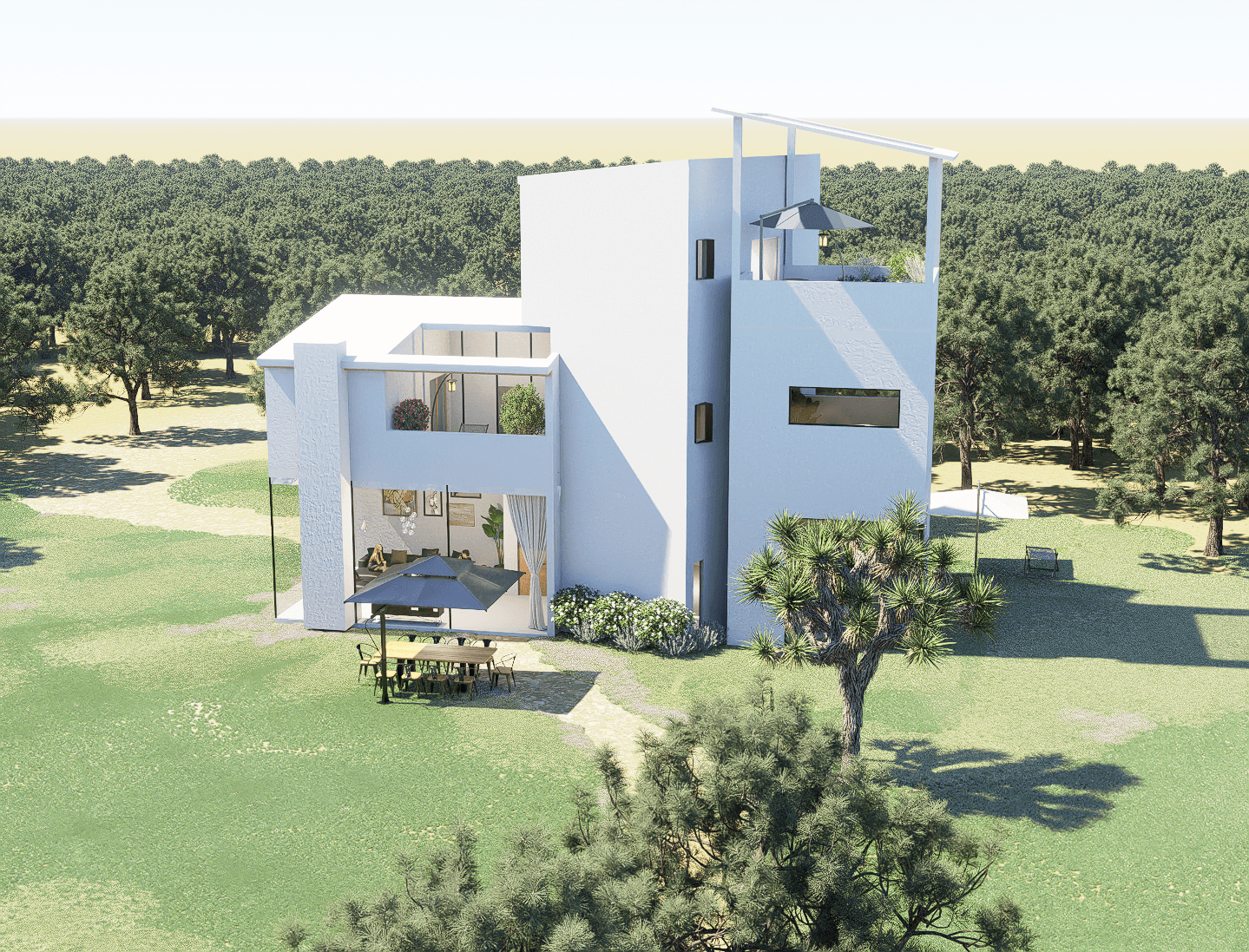
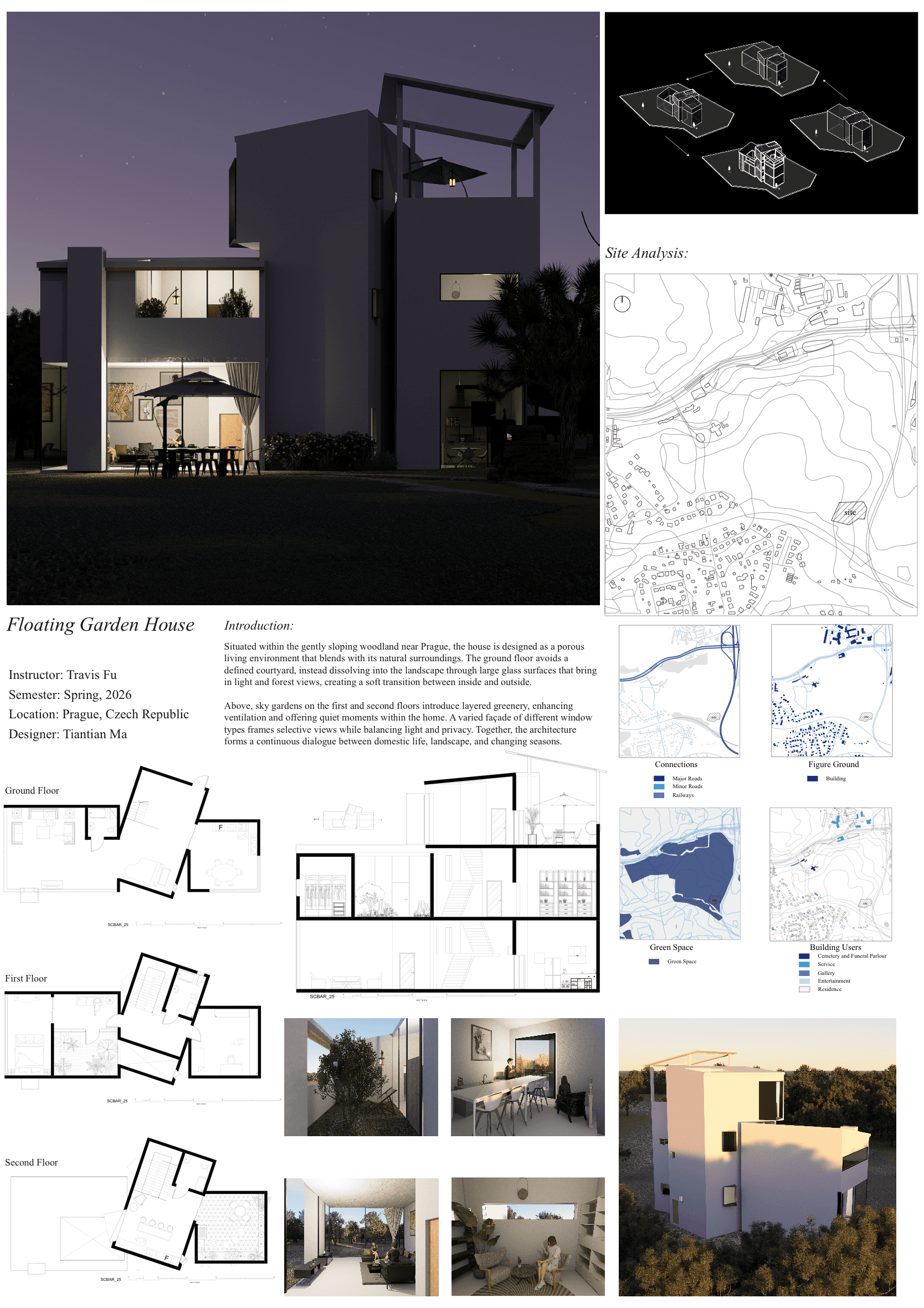
Situated amidst gently sloping woodland near Prague, this residence has been conceived as an open-plan living space that harmonises with its natural surroundings. Rather than featuring a traditional courtyard, the ground floor blends seamlessly with the landscape through expansive glass curtain walls, allowing light and views of the forest to permeate the interior and creating a gentle transition between indoors and outdoors. The upper levels feature a series of roof gardens on the first and second floors, creating a tiered green space that enhances natural ventilation whilst providing areas for relaxation. These elevated gardens bring the atmosphere of the surrounding woodland into the building, fostering a sense of spatial continuity. The façade is characterised by a diverse combination of window types, carefully arranged to frame views, regulate natural light and ensure privacy. Circulation routes follow the subtle undulations of the terrain, echoing the site’s natural gradient and fostering visual connections between spaces. Overall, the project establishes a dialogue between domestic life, the landscape and the changing seasons, transforming the building into an active mediator between the inhabitants and their environment.

About the Artist

Tiantian Ma

My work explores the relationship between architecture, nature, and everyday life. I am interested in how space can dissolve boundaries and create continuous connections between interior and exterior environments. In this project, located in the woodland landscape of Prague, I investigate how a house can become a living system shaped by light, vegetation, and human activity. Inspired by the lifestyle of a mixologist, the design emphasizes layering, transparency, and sensory experience—where spaces unfold gradually, much like the process of crafting a drink. Through the integration of glass, sky gardens, and varied openings, the project seeks to create a balance between openness and intimacy, allowing architecture to engage with both the surrounding forest and the rituals of daily life.
Tiantian Ma

Floating Garden House

January 2026

Medium:

Architecture/Landscape

Situated amidst gently sloping woodland near Prague, this residence has been conceived as an open-plan living space that harmonises with its natural surroundings. Rather than featuring a traditional courtyard, the ground floor blends seamlessly with the landscape through expansive glass curtain walls, allowing light and views of the forest to permeate the interior and creating a gentle transition between indoors and outdoors. The upper levels feature a series of roof gardens on the first and second floors, creating a tiered green space that enhances natural ventilation whilst providing areas for relaxation. These elevated gardens bring the atmosphere of the surrounding woodland into the building, fostering a sense of spatial continuity. The façade is characterised by a diverse combination of window types, carefully arranged to frame views, regulate natural light and ensure privacy. Circulation routes follow the subtle undulations of the terrain, echoing the site’s natural gradient and fostering visual connections between spaces. Overall, the project establishes a dialogue between domestic life, the landscape and the changing seasons, transforming the building into an active mediator between the inhabitants and their environment.

About the Artist

Tiantian Ma

My work explores the relationship between architecture, nature, and everyday life. I am interested in how space can dissolve boundaries and create continuous connections between interior and exterior environments. In this project, located in the woodland landscape of Prague, I investigate how a house can become a living system shaped by light, vegetation, and human activity. Inspired by the lifestyle of a mixologist, the design emphasizes layering, transparency, and sensory experience—where spaces unfold gradually, much like the process of crafting a drink. Through the integration of glass, sky gardens, and varied openings, the project seeks to create a balance between openness and intimacy, allowing architecture to engage with both the surrounding forest and the rituals of daily life.
Tiantian Ma

Floating Garden House

January 2026

Medium:

Architecture/Landscape

Situated amidst gently sloping woodland near Prague, this residence has been conceived as an open-plan living space that harmonises with its natural surroundings. Rather than featuring a traditional courtyard, the ground floor blends seamlessly with the landscape through expansive glass curtain walls, allowing light and views of the forest to permeate the interior and creating a gentle transition between indoors and outdoors. The upper levels feature a series of roof gardens on the first and second floors, creating a tiered green space that enhances natural ventilation whilst providing areas for relaxation. These elevated gardens bring the atmosphere of the surrounding woodland into the building, fostering a sense of spatial continuity. The façade is characterised by a diverse combination of window types, carefully arranged to frame views, regulate natural light and ensure privacy. Circulation routes follow the subtle undulations of the terrain, echoing the site’s natural gradient and fostering visual connections between spaces. Overall, the project establishes a dialogue between domestic life, the landscape and the changing seasons, transforming the building into an active mediator between the inhabitants and their environment.

About the Artist

Tiantian Ma

My work explores the relationship between architecture, nature, and everyday life. I am interested in how space can dissolve boundaries and create continuous connections between interior and exterior environments. In this project, located in the woodland landscape of Prague, I investigate how a house can become a living system shaped by light, vegetation, and human activity. Inspired by the lifestyle of a mixologist, the design emphasizes layering, transparency, and sensory experience—where spaces unfold gradually, much like the process of crafting a drink. Through the integration of glass, sky gardens, and varied openings, the project seeks to create a balance between openness and intimacy, allowing architecture to engage with both the surrounding forest and the rituals of daily life.