Siya Xu

AuraSana

February 2026

Medium:

Architecture

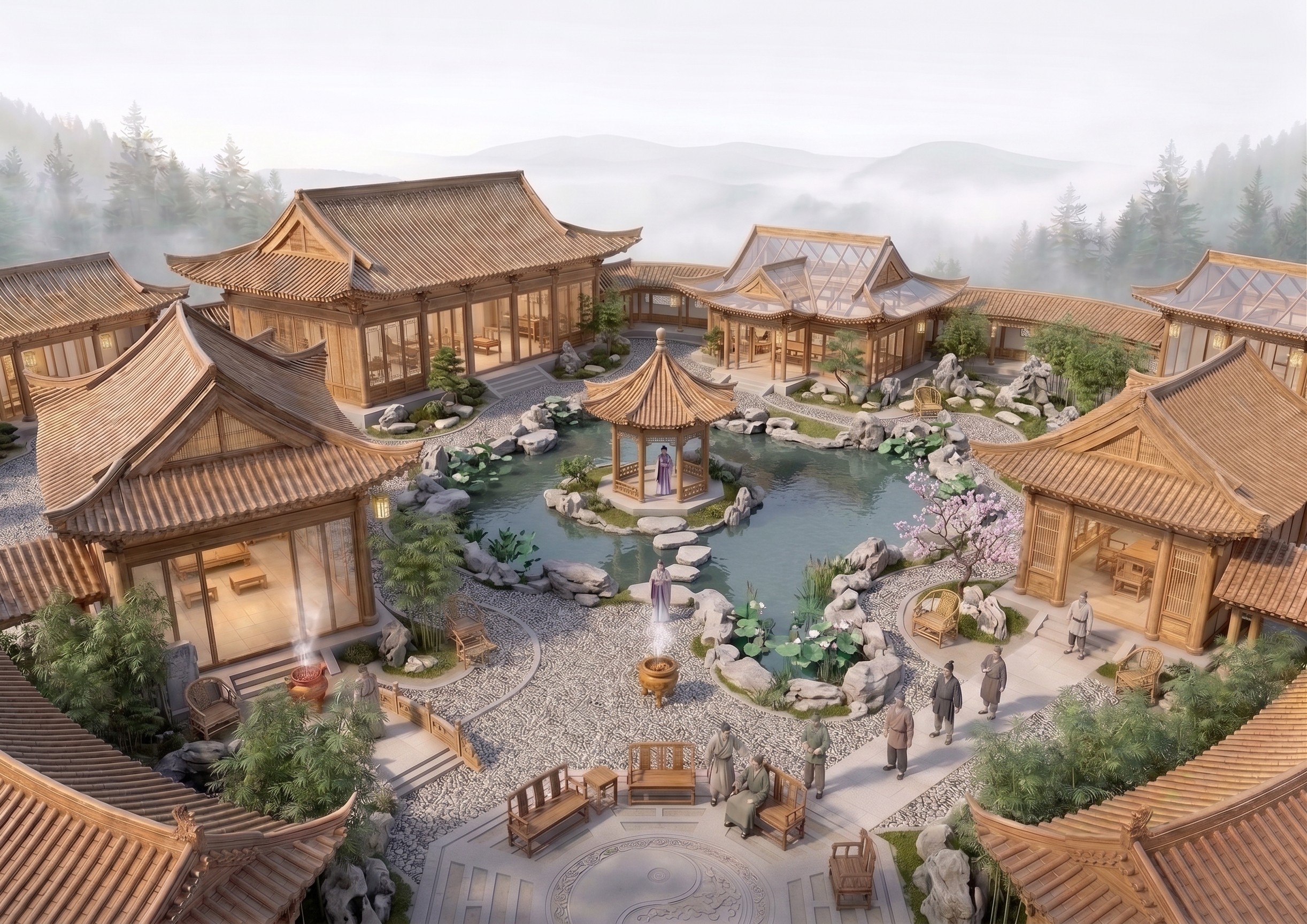
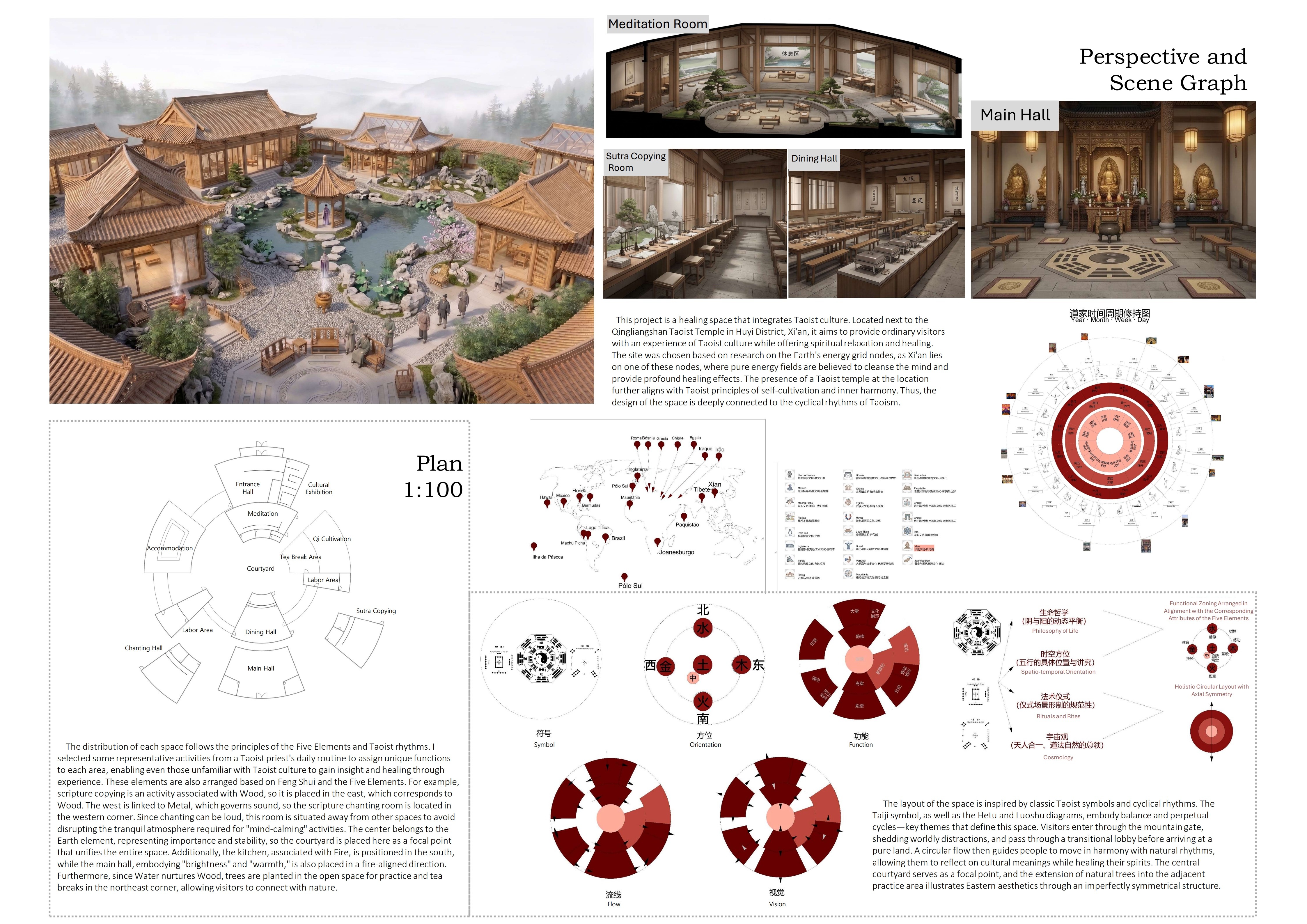
This healing sanctuary, located near the Qingliangshan Taoist Temple in Xi’an, is meticulously positioned on one of the 'Earth’s energy grid nodes'. This strategic choice harnesses 'pure energy fields' believed to cleanse the mind and provide profound healing effects. The architecture is a physical manifestation of 'Taoist cosmology', drawing inspiration from the Taiji symbol and cyclical rhythms to foster perpetual balance. The spatial layout harmonizes with the 'Five Elements (Wu Xing)', where functions are assigned to specific orientations to align with natural energy: 'Spiritual Core': The central courtyard represents the stabilizing 'Earth' element, unifying the entire space. 'Functional Alignment':Areas are strategically placed based on elemental traits, such as placing the 'Wood'-associated Sutra Copying Room in the east and 'Fire'-aligned halls in the south for warmth. 'Acoustic Balance': The western corner, governed by 'Metal', houses the Chanting Hall to manage sound away from tranquil zones. By integrating the daily routines of Taoist priests into a circular visitor flow, the design invites guests to shed worldly distractions and reconnect with the universe’s innate harmony.

About the Artist

Siya Xu

As an Architecture student at Xi'an Jiaotong University, I am a high-output creator driven by 'nature, biological elements, and fantasy world-building'. My work thrives at the intersection of structural logic and imaginative storytelling, often weaving organic forms into vivid, otherworldly narratives. With a deep-rooted foundation in painting and design, I possess a refined 'artist’s eye' for visual expression. As a prolific creator in digital communities, I am dedicated to 'free creation', mastering the art of building immersive universes through both intricate illustrations and compelling text. I seek to channel this creative vitality into professional artistic platforms, turning imaginative, nature-inspired concepts into vibrant, tangible realities.
Siya Xu

AuraSana

February 2026

Medium:

Architecture

This healing sanctuary, located near the Qingliangshan Taoist Temple in Xi’an, is meticulously positioned on one of the 'Earth’s energy grid nodes'. This strategic choice harnesses 'pure energy fields' believed to cleanse the mind and provide profound healing effects. The architecture is a physical manifestation of 'Taoist cosmology', drawing inspiration from the Taiji symbol and cyclical rhythms to foster perpetual balance. The spatial layout harmonizes with the 'Five Elements (Wu Xing)', where functions are assigned to specific orientations to align with natural energy: 'Spiritual Core': The central courtyard represents the stabilizing 'Earth' element, unifying the entire space. 'Functional Alignment':Areas are strategically placed based on elemental traits, such as placing the 'Wood'-associated Sutra Copying Room in the east and 'Fire'-aligned halls in the south for warmth. 'Acoustic Balance': The western corner, governed by 'Metal', houses the Chanting Hall to manage sound away from tranquil zones. By integrating the daily routines of Taoist priests into a circular visitor flow, the design invites guests to shed worldly distractions and reconnect with the universe’s innate harmony.

About the Artist

Siya Xu

As an Architecture student at Xi'an Jiaotong University, I am a high-output creator driven by 'nature, biological elements, and fantasy world-building'. My work thrives at the intersection of structural logic and imaginative storytelling, often weaving organic forms into vivid, otherworldly narratives. With a deep-rooted foundation in painting and design, I possess a refined 'artist’s eye' for visual expression. As a prolific creator in digital communities, I am dedicated to 'free creation', mastering the art of building immersive universes through both intricate illustrations and compelling text. I seek to channel this creative vitality into professional artistic platforms, turning imaginative, nature-inspired concepts into vibrant, tangible realities.
Siya Xu

AuraSana

February 2026

Medium:

Architecture

This healing sanctuary, located near the Qingliangshan Taoist Temple in Xi’an, is meticulously positioned on one of the 'Earth’s energy grid nodes'. This strategic choice harnesses 'pure energy fields' believed to cleanse the mind and provide profound healing effects. The architecture is a physical manifestation of 'Taoist cosmology', drawing inspiration from the Taiji symbol and cyclical rhythms to foster perpetual balance. The spatial layout harmonizes with the 'Five Elements (Wu Xing)', where functions are assigned to specific orientations to align with natural energy: 'Spiritual Core': The central courtyard represents the stabilizing 'Earth' element, unifying the entire space. 'Functional Alignment':Areas are strategically placed based on elemental traits, such as placing the 'Wood'-associated Sutra Copying Room in the east and 'Fire'-aligned halls in the south for warmth. 'Acoustic Balance': The western corner, governed by 'Metal', houses the Chanting Hall to manage sound away from tranquil zones. By integrating the daily routines of Taoist priests into a circular visitor flow, the design invites guests to shed worldly distractions and reconnect with the universe’s innate harmony.

About the Artist

Siya Xu

As an Architecture student at Xi'an Jiaotong University, I am a high-output creator driven by 'nature, biological elements, and fantasy world-building'. My work thrives at the intersection of structural logic and imaginative storytelling, often weaving organic forms into vivid, otherworldly narratives. With a deep-rooted foundation in painting and design, I possess a refined 'artist’s eye' for visual expression. As a prolific creator in digital communities, I am dedicated to 'free creation', mastering the art of building immersive universes through both intricate illustrations and compelling text. I seek to channel this creative vitality into professional artistic platforms, turning imaginative, nature-inspired concepts into vibrant, tangible realities.