Jingqi Sun

Community Centre for Tongji New Village

December 2026

Medium:

Architecture

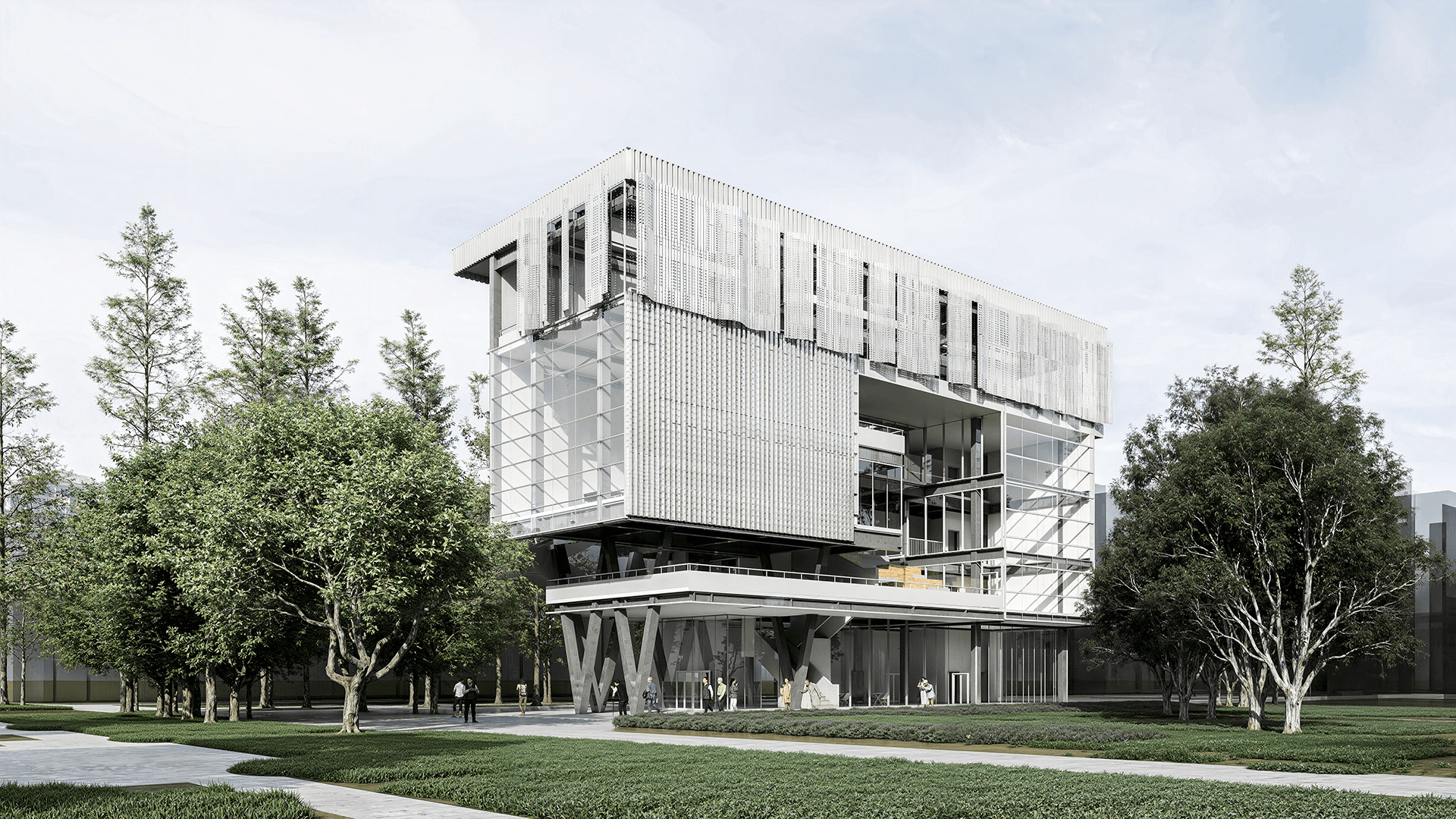
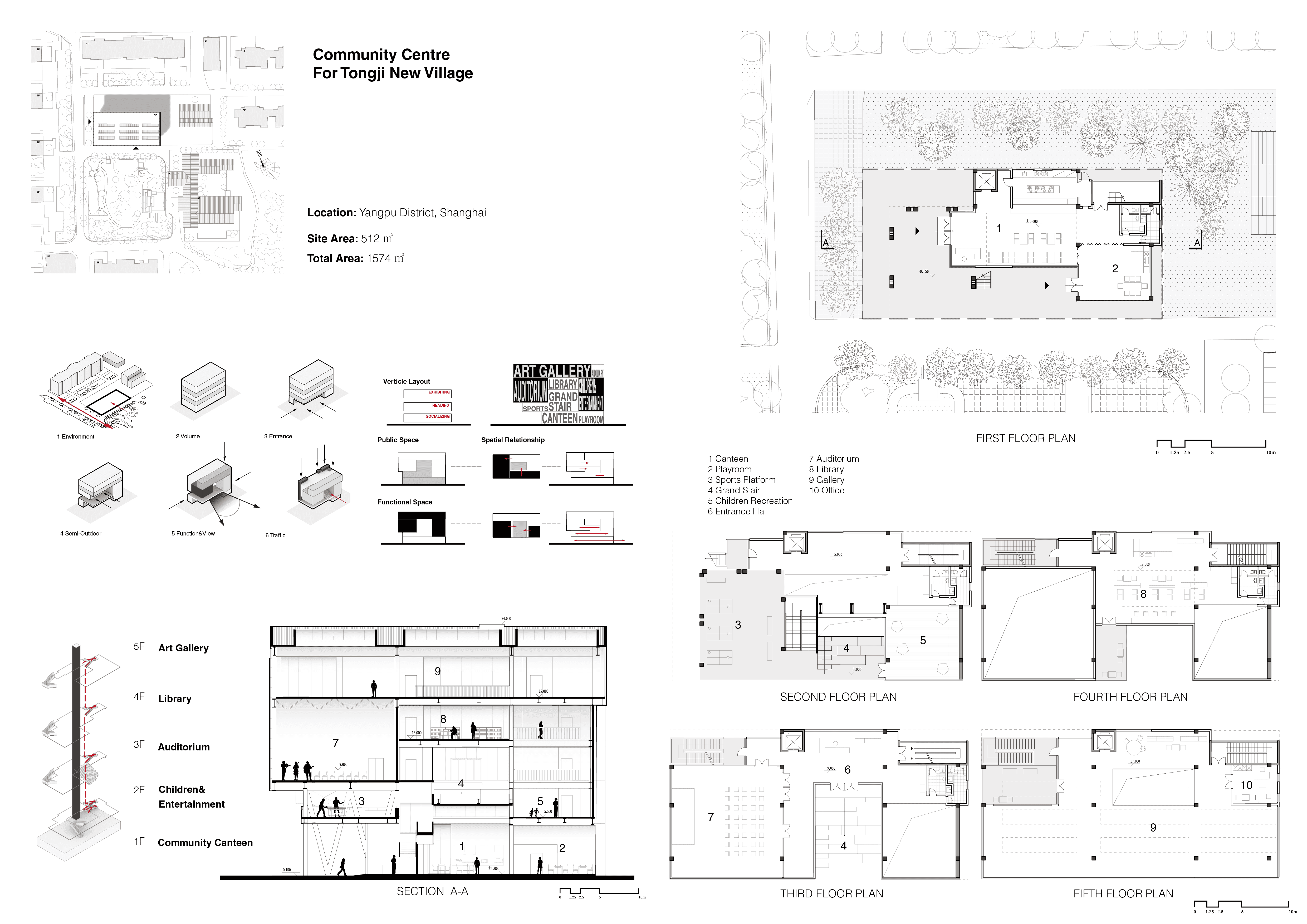
The project reconceives the community center as a vertically integrated spatial assemblage driven by structural logic and programmatic differentiation. Rather than a monolithic volume, the building is composed of fragmented functional blocks, whose displacement generates a system of interstitial voids. These voids operate as “gray spaces,” mediating circulation, visual continuity, and social interaction. The ground level is intentionally recessed to accommodate highly public and collective programs, including dining, sports, and children’s activities, while upper levels host more specialized functions such as reading rooms, multi-purpose halls, and exhibition spaces. A calibrated structural grid organizes the overall composition, enabling both spatial clarity and flexibility. The introduction of V-shaped columns responds to the ground-level setback while reinforcing the structural expression. Programmatic zones of activity and quietness are differentiated both vertically and horizontally, allowing diverse user groups to coexist within a layered spatial system. The project ultimately proposes an alternative to the closed architectural object, framing the building as a porous, dynamic field in which community life unfolds through overlapping visual and spatial relationships.

About the Artist

Jingqi Sun

The designer is an architecture student whose work explores the relationship between structural systems, spatial organization, and social behavior. Emphasizing a performance-driven approach, the work employs grids, structural logic, and rule-based generation to produce adaptable spatial frameworks. Through diagrammatic thinking and analytical methods, conventional typologies are reinterpreted as layered and open systems rather than fixed objects. The design process seeks coherence between structural performance and spatial experience, framing architecture as a flexible system capable of accommodating diverse programs and evolving patterns of use.

Jingqi Sun

Community Centre for Tongji New Village

December 2026

Medium:

Architecture

The project reconceives the community center as a vertically integrated spatial assemblage driven by structural logic and programmatic differentiation. Rather than a monolithic volume, the building is composed of fragmented functional blocks, whose displacement generates a system of interstitial voids. These voids operate as “gray spaces,” mediating circulation, visual continuity, and social interaction. The ground level is intentionally recessed to accommodate highly public and collective programs, including dining, sports, and children’s activities, while upper levels host more specialized functions such as reading rooms, multi-purpose halls, and exhibition spaces. A calibrated structural grid organizes the overall composition, enabling both spatial clarity and flexibility. The introduction of V-shaped columns responds to the ground-level setback while reinforcing the structural expression. Programmatic zones of activity and quietness are differentiated both vertically and horizontally, allowing diverse user groups to coexist within a layered spatial system. The project ultimately proposes an alternative to the closed architectural object, framing the building as a porous, dynamic field in which community life unfolds through overlapping visual and spatial relationships.

About the Artist

Jingqi Sun

The designer is an architecture student whose work explores the relationship between structural systems, spatial organization, and social behavior. Emphasizing a performance-driven approach, the work employs grids, structural logic, and rule-based generation to produce adaptable spatial frameworks. Through diagrammatic thinking and analytical methods, conventional typologies are reinterpreted as layered and open systems rather than fixed objects. The design process seeks coherence between structural performance and spatial experience, framing architecture as a flexible system capable of accommodating diverse programs and evolving patterns of use.
Jingqi Sun

Community Centre for Tongji New Village

December 2026

Medium:

Architecture

The project reconceives the community center as a vertically integrated spatial assemblage driven by structural logic and programmatic differentiation. Rather than a monolithic volume, the building is composed of fragmented functional blocks, whose displacement generates a system of interstitial voids. These voids operate as “gray spaces,” mediating circulation, visual continuity, and social interaction. The ground level is intentionally recessed to accommodate highly public and collective programs, including dining, sports, and children’s activities, while upper levels host more specialized functions such as reading rooms, multi-purpose halls, and exhibition spaces. A calibrated structural grid organizes the overall composition, enabling both spatial clarity and flexibility. The introduction of V-shaped columns responds to the ground-level setback while reinforcing the structural expression. Programmatic zones of activity and quietness are differentiated both vertically and horizontally, allowing diverse user groups to coexist within a layered spatial system. The project ultimately proposes an alternative to the closed architectural object, framing the building as a porous, dynamic field in which community life unfolds through overlapping visual and spatial relationships.

About the Artist

Jingqi Sun

The designer is an architecture student whose work explores the relationship between structural systems, spatial organization, and social behavior. Emphasizing a performance-driven approach, the work employs grids, structural logic, and rule-based generation to produce adaptable spatial frameworks. Through diagrammatic thinking and analytical methods, conventional typologies are reinterpreted as layered and open systems rather than fixed objects. The design process seeks coherence between structural performance and spatial experience, framing architecture as a flexible system capable of accommodating diverse programs and evolving patterns of use.